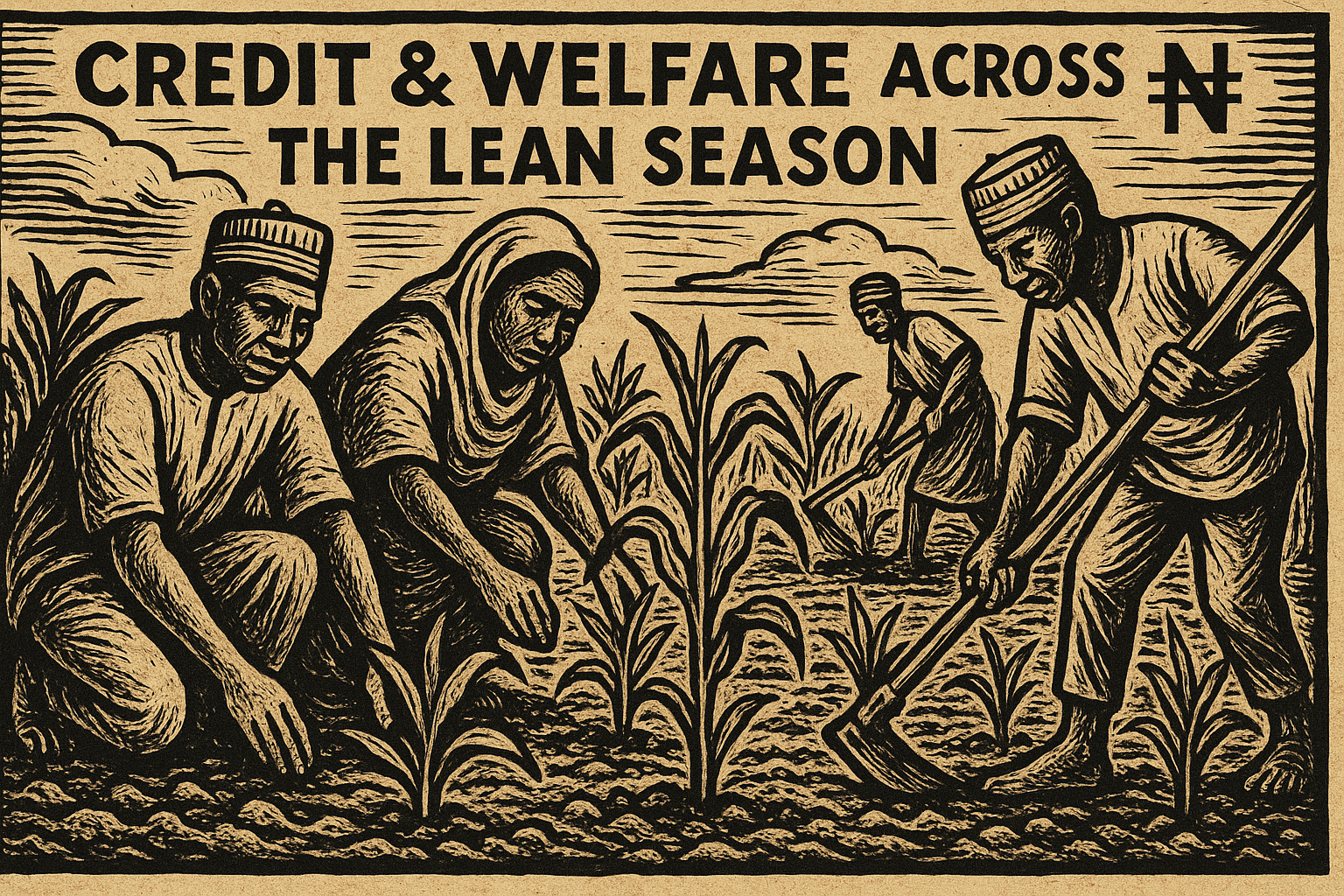
Credit during the lean season in Nigeria

Credit and Welfare Across the Lean Season

The agricultural season naturally induces seasonal variation to prices for things like maize. Is it possible to make money by timing this market? Download Paper Abstract Consumption expenditures in rural areas of low-income countries are highly variable across seasons, yet the literature still lacks a standard framework for asking whether seasonal poverty reflects local credit market failure or poor integration with the broader economy. We develop an intertemporal model of farmers’ portfolio choices under seasonal price risk and borrowing constraints, and derive a sign diagnostic: The amount a farmer is willing to pay for a small risk-free bond (call this price q) must rise in response to a positive income shock if credit constraints bind, but fall if precautionary motives dominate. We apply this framework to a randomized post-harvest loan program in Gombe, Nigeria, and supplement the experiment by also collecting high-frequency data on prices, stocks, and expenditures. The loan sharply reduces the marginal utility of expenditure around delivery, but q never rises over the full follow-up. Precautionary savings, not credit constraints, govern the intertemporal allocation. Receipt of the loan leads to a portfolio rebalancing, as farmers adjust their grain stores, and increase investment. But maize prices increase little after harvest and season-average consumption expenditure effects are small, though the MUE—a more sensitive welfare measure—detects a large and significant improvement around delivery that expenditures miss. We fail to reject the null of well-functioning local financial markets. The binding constraint is poor spatial integration rather than inefficient local allocation—promoting market integration may improve lean-season welfare more than would the local provision of credit. ...


March 27, 2026 · Ethan Ligon
Hands holding umbrella and shields representing risk sharing

Structural Experimentation to Distinguish between Models of Risk Sharing with Frictions in Rural Paraguay

What stops villagers from sharing risk efficiently—limited commitment, moral hazard, or hidden income? We design lab experiments in rural Paraguay whose predictions differ across models, and find that no single friction explains all villages. Download Paper Abstract We conduct dictator-type games in rural Paraguay with different treatments that manipulate players’ information and choice sets. From individuals’ choices in the games, we draw inferences regarding impediments to efficient risk sharing in the larger village supergame. Outcomes from the experimental games suggest that players in most villages are reacting to the kinds of incentives that would be predicted from a private information model with hidden investments, while in others players act in a manner consistent with the predictions of a model with limited commitment. No single one of our models can explain outcomes in all villages, but outcomes in nearly every village are consistent with one or more of our models. ...

October 1, 2020 · Ethan Ligon
Village social network with nodes and edges representing sharing motives

Motives for Sharing in Social Networks

What motivates people in rural villages to share—altruism, reciprocity, or fear of sanctions? We use dictator game variants to measure each motive, and find that reciprocity best predicts real-world gift-giving. Download Paper Abstract What motivates people in rural villages to share? We first elicit a baseline level of sharing using a standard, anonymous dictator game. Then using variants of the dictator game that allow for either revealing the dictator’s identity or allowing the dictator to choose the recipient, we attribute variation in sharing to three different motives. The first of these, directed altruism, is related to preferences, while the remaining two are incentive-related (sanctions and reciprocity). We observe high average levels of sharing in our baseline treatment, while variation across individuals depends importantly on the incentive-related motives. Finally, variation in measured reciprocity within the experiment predicts observed ‘real-world’ gift-giving, while other motives measured in the experiment do not predict behavior outside the experiment. ...

September 1, 2012 · Ethan Ligon