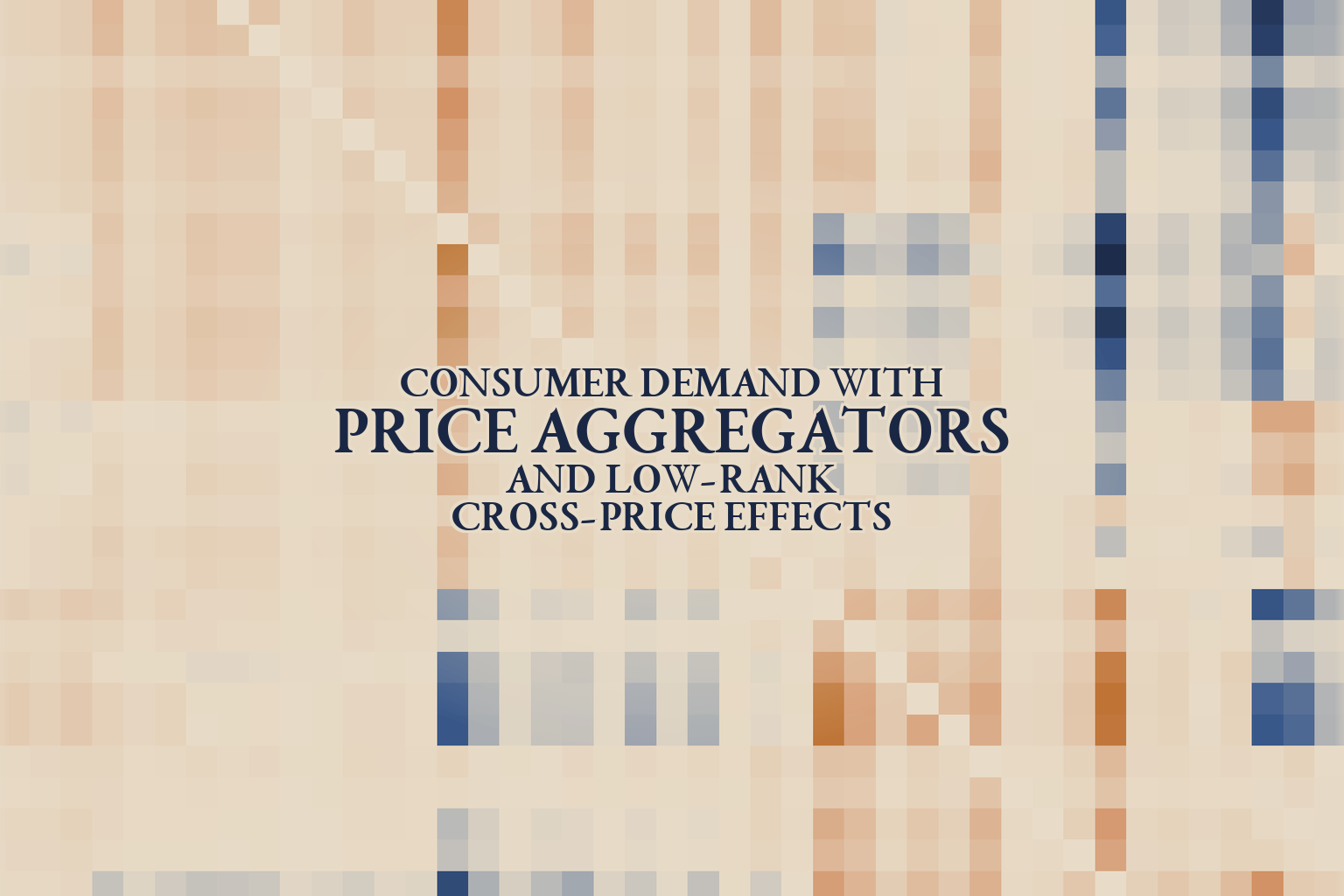
Cross-price elasticity heatmap for ready-to-eat cereals

Consumer Demand with Price Aggregators and Low-Rank Cross-Price Effects

Estimating demand for many goods usually means estimating many cross-price effects. We show that low-rank cross-price structure is equivalent to a small number of "price aggregators," and characterize the preferences behind them. Download Paper Abstract Estimating consumer demands is a bread-and-butter undertaking in applied economics. In general, demand for each good depends on the prices of all goods and services, but for most applications it is impractical to estimate models of such high dimension. In this paper, we consider consumer demand with a low rank of the matrix of cross-price effects, a property implicitly assumed in most empirical settings. First, we show that imposing a low rank is equivalent to introducing functions that we call “aggregators”, where each aggregator maps information from an arbitrarily large vector of prices (and perhaps income) into a scalar. We then provide a complete characterization of the preferences that rationalize demand systems with such aggregators. These results can be used to derive new and flexible forms of demand that can be tailored to applications in various fields of economics. Most commonly-used demand systems (including directly-additive, indirectly-additive, non-homothetic CES and Kimball preferences) can be described with one or two aggregators where the price index may coincide with one of the aggregators. Nested and mixed logit require as many aggregators as nests or consumer types. Aggregators can also be naturally expressed as a function of observed product attributes. Using barcode data on purchases of ready-to-eat cereals, we illustrate how to estimate a simple yet flexible specification of such a demand system with K aggregators, with or without using information on product attributes. ...

March 27, 2026 · Ethan Ligon
Consumption subaggregates and poverty measurement

Consumption Subaggregates Should Not Be Used to Measure Poverty

Can we save money on surveys by measuring poverty with a few goods instead of full consumption? Theory says only if all Engel curves are linear; data from East Africa confirm this shortcut fails in practice. Download Paper Abstract Frequent measurement of poverty is challenging because measurement often relies on complex and expensive expenditure surveys that try to measure expenditures on a comprehensive consumption aggregate. This paper investigates the use of consumption subaggregates instead. The use of consumption subaggregates is theoretically justified if and only if all Engel curves are linear for any realization of prices. This is very stringent. However, it may be possible to empirically identify certain goods that happen to have linear Engel curves given prevailing prices, and when the effect of price changes is small, such a subaggregate might work in practice. We construct such linear subaggregates using data from Rwanda, Tanzania, and Uganda. Our findings show that using subaggregates is ill advised in practice as well as in theory. ...

May 1, 2022 · Ethan Ligon
Informal risk-sharing regimes in rural Tanzania

Inferring Informal Risk-Sharing Regimes: Evidence from Rural Tanzania

Which model of risk sharing fits village data—full insurance, limited commitment, or self-insurance? We devise tests that work without interest rate data and find that Tanzanian villages look like self-insurance. Download Paper Abstract This paper studies informal risk-sharing regimes in a unified framework by examining intertemporal consumption behavior of rural households in Tanzania. We exploit a theoretically-consistent link between interest rates and cross-sectional consumption moments to test alternative risk-sharing models without requiring data on interest rates or assuming a restriction to eliminate the need for such data, which are often unavailable in developing economies. We specify tests that allow distinguishing among models even with temporal dependence in income shocks. Our analysis shows that the consumption pattern in rural Tanzania is consistent with the self-insurance regime, and that risk aversion varies substantially across districts. Imposing a strict condition on interest rates, as often done in prior literature, misses their intertemporal heterogeneity and biases the estimation of risk aversion. ...

September 1, 2020 · Ethan Ligon
Lambda-separable demands and utility functions

All -Separable Demands and Rationalizing Utility Functions

Frisch demands that are separable in the budget multiplier \(\lambda\) turn out to have a surprisingly simple structure. We give a complete characterization: quantities are $λ$-separable iff utility is additively separable. Download Paper Abstract Frisch demands depend on prices and a multiplier \(\lambda\) associated with the consumer’s budget constraint. Subject only to standard, modest, regularity conditions, we provide a complete characterization of all Frisch demand systems and of the utility functions that rationalize these demand systems when either quantities demanded or consumption expenditures are separable in \(\lambda\). Quantities demanded are $λ$-separable if and only if the rationalizing utility function is additively separable in these quantities. In contrast, expenditures are $λ$-separable if and only if marginal utilities for these expenditures belong to one of two simple parametric families. ...

October 1, 2016 · Ethan Ligon
Lambda-separable Frisch demands with utility functions

Some -Separable Frisch Demands with Utility Functions

Many applied demand models assume $λ$-separability without checking that a rationalizing utility function exists. We provide closed-form utility functions for several common families. Download Paper Abstract Many commonly used demand systems in applied economics assume that demands are separable in the multiplier \(\lambda\) on the consumer’s budget constraint. We provide closed-form expressions for the utility functions that rationalize several important families of $λ$-separable Frisch demand systems, including demands that are affine in \(\lambda\) and demands with constant expenditure elasticities. ...

January 1, 2016 · Ethan Ligon