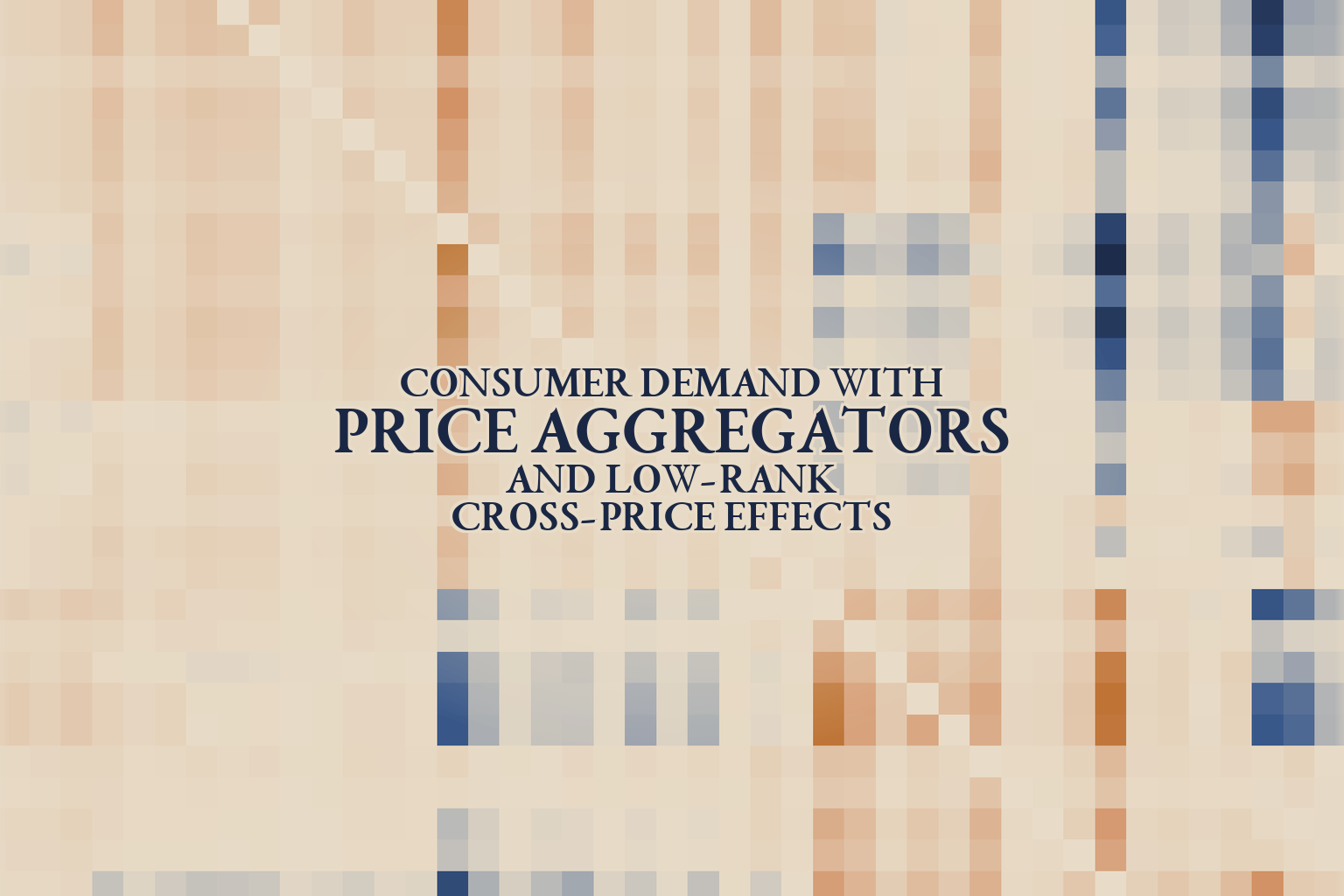
Cross-price elasticity heatmap for ready-to-eat cereals

Consumer Demand with Price Aggregators and Low-Rank Cross-Price Effects

Estimating demand for many goods usually means estimating many cross-price effects. We show that low-rank cross-price structure is equivalent to a small number of "price aggregators," and characterize the preferences behind them. Download Paper Abstract Estimating consumer demands is a bread-and-butter undertaking in applied economics. In general, demand for each good depends on the prices of all goods and services, but for most applications it is impractical to estimate models of such high dimension. In this paper, we consider consumer demand with a low rank of the matrix of cross-price effects, a property implicitly assumed in most empirical settings. First, we show that imposing a low rank is equivalent to introducing functions that we call “aggregators”, where each aggregator maps information from an arbitrarily large vector of prices (and perhaps income) into a scalar. We then provide a complete characterization of the preferences that rationalize demand systems with such aggregators. These results can be used to derive new and flexible forms of demand that can be tailored to applications in various fields of economics. Most commonly-used demand systems (including directly-additive, indirectly-additive, non-homothetic CES and Kimball preferences) can be described with one or two aggregators where the price index may coincide with one of the aggregators. Nested and mixed logit require as many aggregators as nests or consumer types. Aggregators can also be naturally expressed as a function of observed product attributes. Using barcode data on purchases of ready-to-eat cereals, we illustrate how to estimate a simple yet flexible specification of such a demand system with K aggregators, with or without using information on product attributes. ...

March 27, 2026 · Ethan Ligon
Credit during the lean season in Nigeria

Credit and Welfare Across the Lean Season

The agricultural season naturally induces seasonal variation to prices for things like maize. Is it possible to make money by timing this market? Download Paper Abstract Consumption expenditures in rural areas of low-income countries are highly variable across seasons, yet the literature still lacks a standard framework for asking whether seasonal poverty reflects local credit market failure or poor integration with the broader economy. We develop an intertemporal model of farmers’ portfolio choices under seasonal price risk and borrowing constraints, and derive a sign diagnostic: The amount a farmer is willing to pay for a small risk-free bond (call this price q) must rise in response to a positive income shock if credit constraints bind, but fall if precautionary motives dominate. We apply this framework to a randomized post-harvest loan program in Gombe, Nigeria, and supplement the experiment by also collecting high-frequency data on prices, stocks, and expenditures. The loan sharply reduces the marginal utility of expenditure around delivery, but q never rises over the full follow-up. Precautionary savings, not credit constraints, govern the intertemporal allocation. Receipt of the loan leads to a portfolio rebalancing, as farmers adjust their grain stores, and increase investment. But maize prices increase little after harvest and season-average consumption expenditure effects are small, though the MUE—a more sensitive welfare measure—detects a large and significant improvement around delivery that expenditures miss. We fail to reject the null of well-functioning local financial markets. The binding constraint is poor spatial integration rather than inefficient local allocation—promoting market integration may improve lean-season welfare more than would the local provision of credit. ...

March 27, 2026 · Ethan Ligon
Drought in Uganda

Risk-Sharing Tests and Covariate Shocks: Drought, Floods, and Pests in Uganda

"Covariate" shocks such as droughts or floods may affect everyone, but not everyone is affected equally. We devise ways to test the extent to which the effects of these shocks are shared. Download Paper Abstract Efficient risk-sharing implies a simple factor structure for marginal utilities of expenditure (MUEs): Pareto weights divided by a common price. The standard approach infers MUEs from total expenditures, implicitly assuming homothetic preferences, unitary income elasticities, and identical price elasticities. Risk-sharing tests using total expenditures work for idiosyncratic shocks (budgets change, but not prices), but not ``covariate’’ shocks (prices change). We describe all preferences which permit one to infer MUEs from expenditures, and estimate nonhomothetic MUEs to test whether covariate shocks are shared efficiently in Uganda. This delivers sensible results; the standard approach suggests that droughts, floods, and pests are beneficial. ...

August 13, 2025 · Ethan Ligon
Spatial procurement in the tomato processing industry

Spatial Procurement of Farm Products and the Supply of Processed Foods

How do transportation costs shape the geography of food processing? We model spatial procurement by a California tomato processor and estimate how energy prices affect the supply of processed foods. Download Paper Abstract Increased transportation and logistical costs in agricultural markets have affected the spatial allocation of production in the agricultural and food sectors of the economy. We develop a spatial model of farm product procurement by a food processor, designed to capture the effects of supply-chain disruptions on the spatial procurement of farm products in the processed food sector. We use detailed data on production and procurement by a large California tomato processor to estimate the key parameters of the model which allow us to calculate the price elasticity of supply for California tomato paste production and describe how changes in energy prices and transportation costs for primary agricultural products affect the supply of processed food. ...

February 1, 2024 · Ethan Ligon
Expenditure gains by decile from agricultural vs non-agricultural growth

Estimating the Relative Benefits of Agricultural Growth on the Distribution of Expenditures

GDP growth originating in agriculture benefits poorer households 3–4 times more than equivalent growth from non-agriculture. An earlier version of this result was featured in the World Development Report 2008. Download Paper Abstract Does the sectoral composition of aggregate economic growth affect poverty? We ask whether agricultural growth in developing countries increases the expenditures of poorer households more than growth in other sectors. While some reduced form analyses have tackled this question using either country-level time series data, regional panel data for one country, or cross-sectional country data, this paper is unusual in using panel data for many countries. We improve on much of the existing literature by devising an instrumental variables strategy to correct for the endogeneity of sectoral GDP growth, involving averaging over sectoral income growth rates for neighboring countries. Our principal finding from our instrumental variable estimator is that the estimated elasticities associated with growth in agricultural income are significantly greater than for non-agricultural income for all but the extreme top and bottom deciles. In the middle range of the income distribution the effect of a given GDP growth due to agriculture is 3–4 times larger than if it was due to non-agricultural activities. Having established that on average growth in GDP originating in agriculture is more beneficial for poorer deciles, we finally explore whether this is a pattern which holds across different groupings of countries. A second important finding is that there is heterogeneity across some groupings. Most particularly, we find that it is the poorest people in the poorest countries for whom agricultural income growth is the most beneficial. ...

September 1, 2018 · Ethan Ligon
Risk management in the cooperative contract

Risk Management in the Cooperative Contract

Cooperatives help members manage marketing risk within a season, but not production risk across years. We show how the multi-year cooperative relationship can also provide limited crop insurance. Download Paper Abstract Agricultural cooperatives have long played an important role in helping their members manage risk, though they do a much better job of helping members manage some sorts of risk than others. In particular, co-ops are good at helping members manage marketing risk, but seem not to be particularly good at helping their members manage production risk. This paper argues that by taking advantage of the multi-year nature of most members’ relationship with the cooperative, the cooperative can also provide a useful, though limited, form of insurance against crop shortfalls. ...

December 1, 2009 · Ethan Ligon
Agricultural contracts data and research needs

Agricultural Contracts: Data and Research Needs

Contracting is pervasive in agriculture, yet systematic data on contract terms remains scarce. We identify key data gaps and propose a framework for data collection that individual researchers can build on. Download Paper Abstract Contracting is widespread in agriculture, yet there is no systematic data collection on the nature and importance of agricultural contracts. We argue that such data collection is needed to build further knowledge and support more specific research projects. Collecting data from individual contracting parties is difficult, but a summary of responses about specific contract characteristics coupled with sectoral descriptions would provide general information that individual researchers can utilize when launching investigations on more specific topics. ...

December 1, 2007 · Ethan Ligon
Using production data to design efficient contracts

Using Production Data to Design Efficient Contracts

What does an optimal agricultural contract look like? We show how to use production data to design incentive-compatible contracts, and apply the method to California's processing tomato industry. Download Paper Abstract This article shows how available production data can be used to construct the terms of an efficient contract. The approach is applied to the design of a contract for processing tomatoes, a commodity for which a variety of different contractual provisions are used in practice. The analysis yields estimates of the efficient level of incentive intensity, the efficient degree of risk sharing, and the welfare cost of using suboptimal contract terms. ...

August 1, 2004 · Ethan Ligon
Estimation of an efficient tomato contract

Estimation of an Efficient Tomato Contract

What does an efficient contract between tomato growers and processors look like? We estimate an agency model and find that existing quality measurement improves efficiency, but information constraints still cost about 1% of mean compensation. Download Paper Abstract An agency model of contracts used in California’s processing-tomato industry is estimated in three stages. We first estimate growers’ stochastic production possibilities, and then, for a given vector of preference parameters, compute an optimal compensation schedule. Finally, we compare computed compensations with actual compensations and choose preference parameters to minimise distance between the two. Assuming perfect competition and risk neutrality for processors, we obtain an estimate of 0.08 for growers’ measure of constant absolute risk aversion, and find that growers who face higher-powered incentives produce higher levels of soluble solids, at a cost that is 1.8 per cent greater than otherwise. Efficiency losses from information constraints are 1 per cent of mean compensation, whereas existing quality measurement improves efficiency by 1.08 per cent. ...

June 1, 2002 · Ethan Ligon
Optimal risk in agricultural contracts

Optimal Risk in Agricultural Contracts

When farmers produce under contract, there is a tension between risk and incentives. We provide a simple characterization of optimal risk and show that "less risk" need not mean "smaller variance." Download Paper Abstract When farmers produce under contract, there may be an important tension between risk and incentives. We provide a simple characterization of the optimal risk in any production system. We also show that “less risk” need not imply “smaller variance,” and that while at the margin the behavior of risk-averse farmers may appear to be nearly risk-neutral, it does not follow that one can generally treat such producers “as if” they were risk-neutral without being greatly led astray. ...

January 1, 2002 · Ethan Ligon
Policing mechanisms in agricultural contracts

Policing Mechanisms in Agricultural Contracts

How do processors ensure that growers deliver the quality they promise? We identify four policing instruments—input control, monitoring, quality measurement, and revenue sharing—used in California produce contracts. Download Paper Abstract We examine mechanisms of coordination in agricultural contracts, with an approach intended to advance understanding of social relations of production and distribution of power in agrofood systems. Through analysis of contracts between farmers and intermediaries for California fruits and vegetables, we identify three functions of contracts: they help to coordinate production, they provide incentives to induce particular behaviors, and they allow farmers and intermediaries to share risk. These functions are implemented via four policing instruments: input control, monitoring, quality measurement, and revenue sharing, which are employed by intermediaries to mitigate blind spots in contracts and to control farmers’ actions and the quality of their output. ...

September 1, 2001 · Ethan Ligon
Agricultural markets as relative performance evaluation

Agricultural Markets as Relative Performance Evaluation

Spot markets for agricultural commodities reveal information about grower quality that contracts can exploit. We show how market prices serve as a form of relative performance evaluation. Download Paper Abstract We develop a model in which an agricultural spot market serves as a relative performance evaluation device. In this setting, the market price conveys information about factors common to all growers, such as weather, which helps to distinguish the quality of an individual grower’s effort from factors beyond the grower’s control. We derive the optimal contract between a processor and a grower and show that the contract offers the grower partial insurance against market price fluctuations while retaining incentives for effort. ...

May 1, 2001 · Ethan Ligon
Incentive instruments in fruit and vegetable contracts

Incentive Instruments in Fruit and Vegetable Contracts

Contracts between growers and handlers use four instruments—input control, field visits, quality measurement, and residual price risk—to align incentives and coordinate production in California produce markets. Download Paper Abstract We examine the structure of contractual relations between growers and first handlers in California fruit and vegetable markets. We identify four generic instruments—input control, field visits, quality measurement, and residual price risk—which are used to coordinate relations between growers and first handlers and which help to alleviate information asymmetries and align incentives between contracting parties. ...

September 1, 1999 · Ethan Ligon
Agricultural supply response under contract

Agricultural Supply Response Under Contract

How does contracting change a farmer's supply response to price changes? When intermediaries absorb risk and farmers have private information, supply response is dampened relative to spot-market farming. Download Paper Abstract We consider four environments in which agricultural producers might operate, studying the role of price and production risk in shaping farmers’ supply-response decisions. In the first two environments, farmers market their own produce and are risk neutral and risk averse, respectively. In the third, farmers are risk averse, but risk neutral intermediation predicts that farmers should not face any production or price risk. In the final environment, risk neutral intermediation continues but the possibility of private information for farmers is admitted, which rationalizes exposure to production and price risk and suggests that a farmer’s response to a change in expected price will be less pronounced than in other environments. ...

August 1, 1999 · Ethan Ligon
Producer price risk and quality measurement

Producer Price Risk and Quality Measurement

Why don't contracts fully insure growers against price risk? Because price conveys information about quality that direct measurement misses, so efficient contracts leave growers exposed to some price risk. Download Paper Abstract Risk-averse farmers in the produce industry grow a product whose market price is often quite unpredictable. Shippers or other intermediaries shield the farmer from much of this price risk; however, actual contracts between growers and shippers vary considerably across commodities in the residual price risk growers face. We hypothesize that imperfect quality measurement results in a moral hazard problem, and that price provides additional information regarding quality. As a consequence, an efficient contract does not shield growers from all idiosyncratic price risk. ...

August 1, 1999 · Ethan Ligon